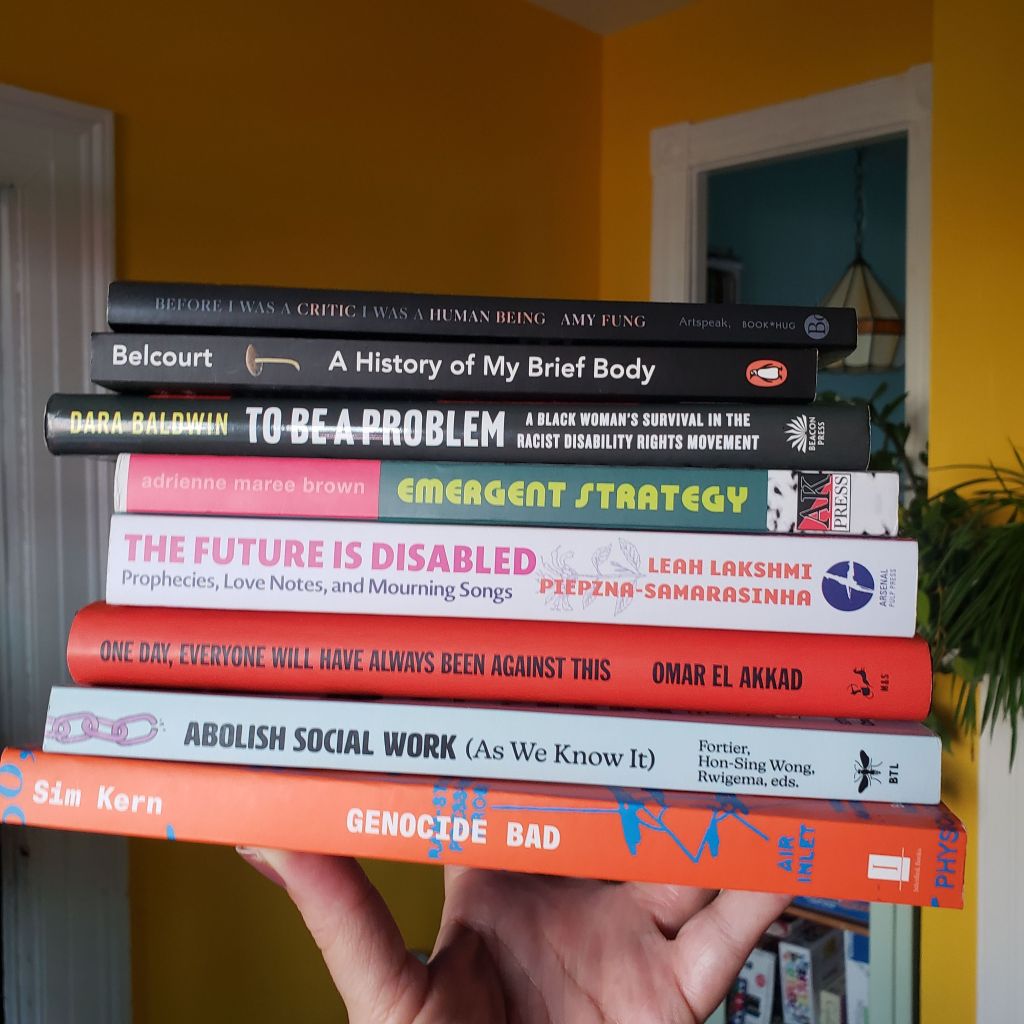
Been getting lots of reading done lately, which means it’s time for another round of micro-reviews! From bottom to top:
Sim Kern, Genocide Bad: Notes on Palestine, Jewish History, and Collective Liberation. Interlink Books, 2025.
- Months ago, Sim Kern made an appeal online for folks to pre-order their book to keep it from being suppressed in the US market, so I did (through the glorious Running the Goat in Tors Cove, NL). Very much worth the wait and worth the read! Kern’s a hell of a researcher and a compelling storyteller. Top marks for effective knowledge translation.
Craig Fortier, Edward Hon-Sing Wong and MJ Rwigema, editors, Abolish Social Work (As We Know It). Between The Lines, 2024.
- Provocative title, valuable volume. The book does a great job of highlighting issues and debates in social work (although it’s worth noting that many of these debates aren’t all that different than the ones outlined in Bailey and Brake’s Radical Social Work back in the 70s). Impressive range of voices.
Omar El Akkad, One Day Everyone Will Have Always Been Against This. McClelland & Stewart, 2025.
- Stunning. Elegant at the sentence level, gut-wrenching in content. Equal parts condemnation of anti-Muslim violence, and meditation on the craft of writing about/amid such violence. Interesting coincidence: El Akkad writes at one point about covering the “Toronto 18” arrests in 2006, while one of the chapters in Abolish Social Work* features writing by one of the men imprisoned for his role in that plot.
Leah Lakshmi Piepzna-Samarasinha, The Future is Disabled: Prophecies, Love Notes, and Mourning Songs. Arsenal Pulp Press, 2022.
- Gorgeous. Essential. Generous. Damning. Funny. Hopeful.
adrienne maree brown, Emergent Strategy: Shaping Change, Changing Worlds. AK Press, 2017.
- An antidote to the grind of the extractive capitalist hellscape we’re all living in. Practical tools for being and doing better towards one another as humans in community.
Dara Baldwin, To Be a Problem: A Black Woman’s Survival in the Racist Disability Rights Movement. Beacon Press, 2024.
- A reflection on the entrenched racism of the USian policy landscape, similar to what Musa al-Gharbi’s We Have Never Been Woke reports in the contest of US higher education. A useful reminder of how mainstream rights movements replicate the power dynamics and abuses they purport to challenge.
Billy-Ray Belcourt, A History of My Brief Body. Penguin, 2021.
- Prayer, longing, beauty, mis-fit, sublimation, poetry, love. An exploration of what colonial violence does to the very bones of a person, but also of the infinite tessellation of possibilities for Indigenous resistance/existence amid/against the patterns of imperialism.
Amy Fung, Before I Was a Critic I Was a Human Being. Book*hug Press, 2019.
- This one’s a re-read; I finished Belcourt’s book and reached for Fung’s because there’s a deep resonance between the two. Both books do what El Akkad’s collection also does: they grapple with the “how” of writing about/amid/against colonial violence.** I would love for more people to read this one, because I think it’s doing something important and I want somebody to talk to about it.
*Chapter 8, “A Masterpiece We Can Call Abolition: Reflections from the Pages of Cell Count.” Sena Hussain, Nolan Turcotte, and Zakaria Amara.
**Now that I write this, I’m thinking that all three books would be fantastic together as part of a graduate course on nonfiction writing, or on writing about colonial trauma, or on the complexities of identity, or any number of subject areas, really.
 Andreae Callanan