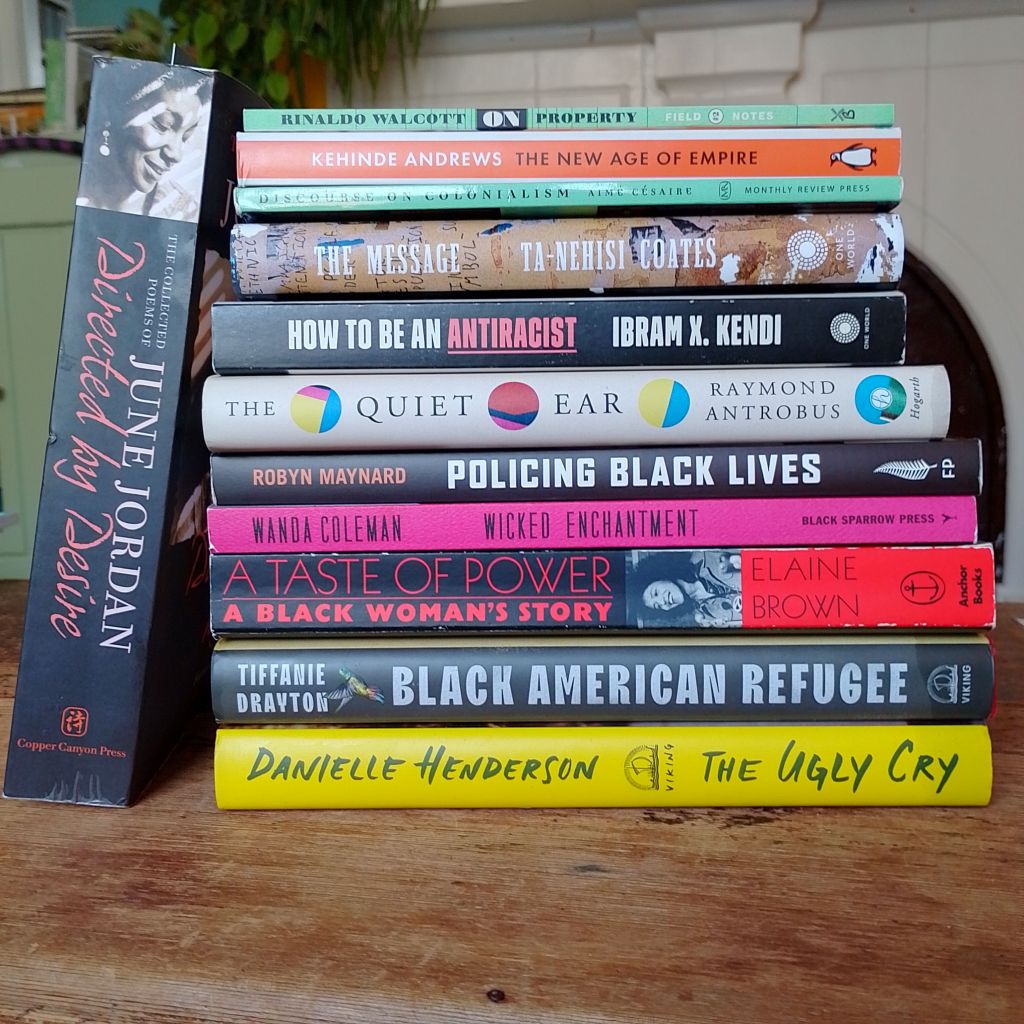
I’ve been trying to spend less time scrolling and more time reading, partly just to give my attention span some much needed space to expand into, and partly to step back and get some perspective on *the horrors.* Since last month was February, I decided I’d move all the books by Black authors to the tops of my various TBR piles. Obviously, there are books by Black authors among my reading lists all year long (see: my previous micro-reviews), but I’ve never spent a month exclusively reading Black authors before. There was no real connecting theme, aside from the fact that they’re all books I’ve bought and so they’re all on topics that interest me (personal memoir, anti-imperialism, poetry of liberation…).
And so, I offer to you: Micro-Reviews: Black History Month Edition.
Rinaldo Walcott, On Property. Biblioasis, 2021.
- This is a treatise on prison abolition, but Walcott cleverly approaches the subject via a critique of private property, beginning with the premise that Black people have a unique relationship to property, having historically been property — a premise that really strips back any pretense of civility around the reality of chattel slavery. A short, thought-provoking read.
Kehinde Andrews, The New Age of Empire: How Racism and Colonialism Still Rule the World. Penguin, 2021.
- One of my favourite books of the last month’s reading. Andrews’s prose style is sprightly and irreverent, and his research is deep-reaching and incisive. Andrews takes a step back to show us how the global crises of today are connected to each other, and to the crises of the past 600 years. Excellent.
Aimé Césaire, Discourse on Colonialism. Translated by Joan Pinkham, introduction by Robin D. G. Kelley. Monthly Review Press, 2001. (Original French version 1955.)
- Oooh this was some delicious anticolonial, anticapitalist writing, a deeply poetic, deeply felt, furious condemnation of “the west.” Much more timely than I had anticipated. Kelley’s introduction provides useful context for the specificities of Césaire’s life and time, but even without that information, the piece stands up.
Ta-Nahisi Coates, The Message. One World, 2024
- I’d been looking forward to reading this since seeing clips of some of Coates’s encounters with interviewers during the book’s press tour. The whole book is stunning, but the section on Palestine feels especially crucial. The line, “The systems we oppose are systems of oppression, and thus inherently systems of cowardice” is *chef’s kiss.*
Ibram X. Kendi, How to Be an Antiracist. One World, 2019, 2023.
- I really liked that Kendi included notes indicating where he’d made changes between the first edition of the book and this updated print. I did find his prose a bit hard to follow at times — his style can quite oratorical, and I frequently found myself having to double back. A lot of the book focuses on US domestic policy, institutions (e.g. HBCUs), etc., but much of the theory is broadly applicable.
Raymond Antrobus, The Quiet Ear: An Investigation of Missing Sound. Hogarth, 2025.
- A gorgeous reflection on in-between-ness, which is also wholeness, which is complete and beautiful in its both-and-ness.
Robyn Maynard, Policing Black Lives: State Violence in Canada from Slavery to the Present. Fernwood Press, 2017.
- Heavy, as one would expect, but very readable and excellently researched. The sections on immigrant/newcomer surveillance and detention are especially chilling right now. Maynard has just launched an expanded edition, which I look forward to reading.
Wanda Coleman, Wicked Enchantment: Selected Poems. Black Sparrow Press, 2020.
- Hot damn, I can’t believe I hadn’t read Wanda Coleman until now! I first heard about her via Terrance Hayes’s essays in his book Watch Your Language (which is also superb). Hayes calls Coleman “a grenade of brilliance, boasts, and braggadocio,” and the poems back that assertion up in the best possible way.
Elaine Brown, A Taste of Power: A Black Woman’s Story. Anchor Books, 1993.
- An eye-opening view of both the values and accomplishments of the Black Panther Party, and of the party’s challenges, frustrations, and eventual dissolution. Brown exposes the conflicts and contradictions within the party’s leadership — including deep-rooted, violent misogyny — while remaining steadfast to the party’s ideals. Frequently funny, very sweary, often heartbreaking, and occasionally a bit steamy.
Tiffanie Drayton, Black American Refugee: Escaping the Narcissism of the American Dream. Viking, 2022.
- Drayton writes as an immigrant to the US from Trinidad and Tobago who ultimately turns her back on America’s false promises and vitriolic racism, finding happiness in returning to her country of origin. She frames America as an abusive partner, and her narrative of that relationship is compelling and convincing.
Danielle Henderson, The Ugly Cry: How I Became a Person (Despite my Grandmother’s Horrible Advice). Viking, 2021.
- Oh god! I loved this book so much! And I wanted to be friends with teenage Dani so bad! Beautiful, gut-wrenching. Very, very funny, but in the way that people are funny when terrible things have happened to them. You know.
June Jordan, Directed by Desire: The Collected Poems. Copper Canyon Press, 2007.
- I’m only about halfway through this one, because 630 pages of poems is A LOT of poems, but the work is just beautiful. I’m intrigued by how many of Jordan’s pieces are occasional poems, and maybe I’m a little bit inspired to write more occasional verse? Maybe? The occasional pieces read as these beautiful, intimate snapshots of global events. I tend to shy away from that kind of writing myself, but why?
A note: I realized as I wrote this that I had arranged the books in the photo so that all the male writers were on the top of the stack and all the women were underneath, but that’s just because all the men’s books were smaller! Absolutely not a statement on anything other than the physical dimensions of the books themselves.
 Andreae Callanan