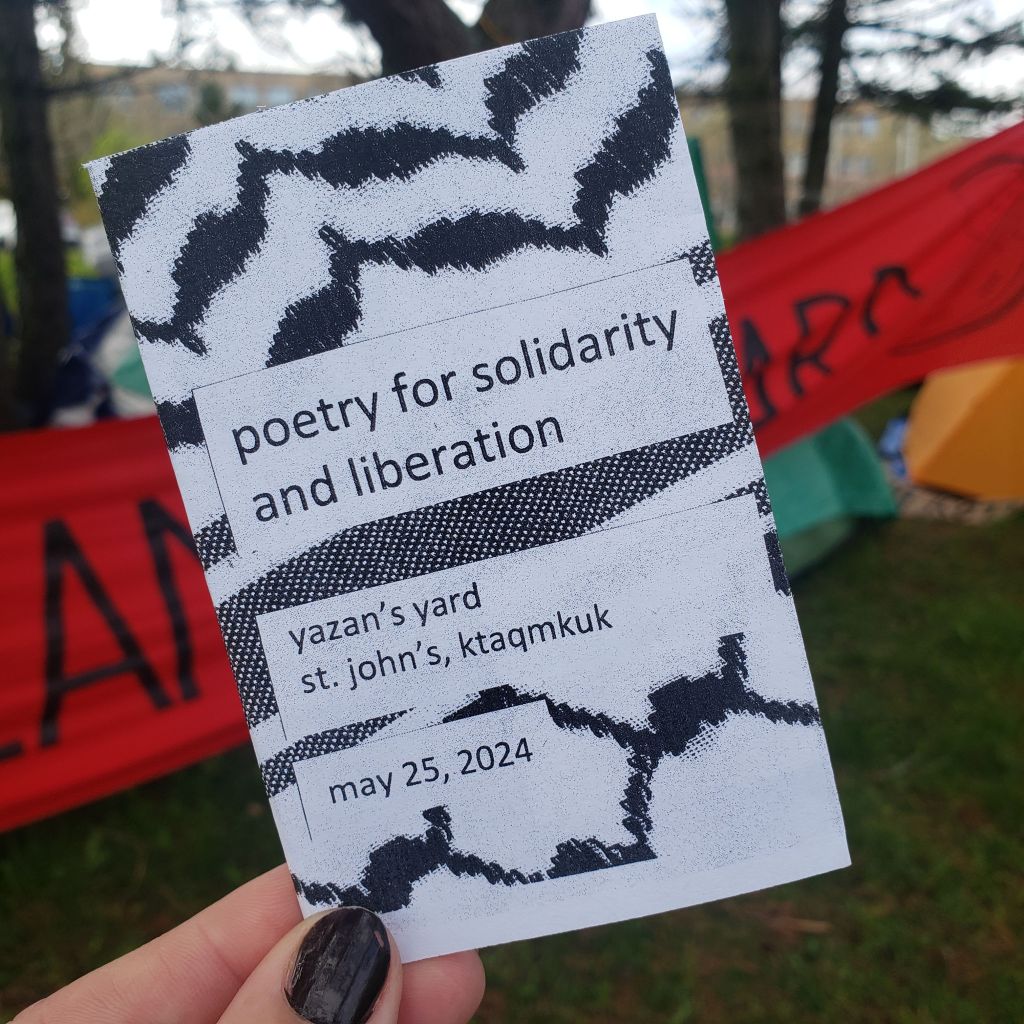
The text on this page comes from a zine I put together to bring to a teach-in on poetry as a tool of solidarity and liberation at the Yazan’s Yard encampment at Memorial University.
If you’d like to download the zine, it’s right here:
Not sure how to cut and fold a one page zine? Instructions are right here: Let’s make a one page zine!
“We teach life, sir.”
You may have seen this quote in posts out of Gaza. It comes from a 2011 poem by Palestinian-Canadian spoken word artist Rafeef Ziadah.
The phrase “we teach life, sir” has come to represent Palestinian resilience, ingenuity, strength, generosity, and humanity in the face of oppression.
“We teach life, sir.
We Palestinians teach life after they have occupied the last sky.
We teach life after they have built their settlements and apartheid walls, after the last skies.
We teach life, sir.”
(The complete piece is easy to find on YouTube! You should look it up if you haven’t seen it before.)
Poetry is powerful! Poetry can be a tool of liberation for oppressed people, and a way for allies to give our solidarity a voice.
A poem can be a container for big feelings.
The feelings many of us have experienced these past months are too big to process. A poem can’t make sense of everything, but it can help make space to process some things.
Prompt 1: I know this much is true
What is one true thing you have learned from the struggle for Palestinian liberation?
Maybe it’s something about global politics, or maybe it’s something about your community. Maybe you’ve learned something new about yourself, or about someone you care about. Maybe it’s a skill or a technique or a recipe or a song.
Write about it!
Prompt 2: One image
People have referred to siege on Gaza as “the world’s first livestreamed genocide.” We’ve seen images of horror and dehumanization, and also images of protest, community, love, and resilience. What’s one image from the last eight months – from online, or that you’ve viewed first-hand – that you’ll never forget?
Not a visual person? What about a sound you’ve heard? Something you’ve tasted? A smell? A tactile sensation? Write about it!
Prompt 3: A poem can be a prayer
Poetry can be a powerful form of incantation. Repetition of lines (for example, “We teach life, sir”) or of the beginnings of lines (for example, “If I must die…”) helps us tap into something beyond the words on the page. If prayer isn’t a concept that resonates with you, try thinking about a poem as a spell, a plea, an entreaty (or, if your poem comes from a place of righteous rage: a hex).
What do you ask of the universe right now?
Write about it!
Prompt 4: Conversation
If you open up this page, you’ll find four poems by Palestinian poets on the back: “If I must die” by Refaat Alareer, “Fuck Your Lecture on Craft, My People Are Dying” by Noor Hindi, “The Deluge and the Tree” by Fadwa Touqan, and “Things You May Find Hidden in My Ear” by Mosab Abu Toha.
Choose a poem and read it. What emotions does it bring up in you? What questions does it leave you with? Who is the poet to you: are they your kin? A teacher? A neighbour? A stranger? What do you want to say back to them?
Write about it!
“A revolutionary poem … reminds you (for you have known, somehow, all along, maybe lost track) where and when and how you are living and might live—it is a wick of desire. It may do its work in the language of images of dreams, lists, love letters, prison letters, chants, filmic jump cuts, meditations, cries of pain, documentary fragments, blues, late-night long-distance calls…
Any truly revolutionary art is an alchemy through which waste, greed, frozen indifference, ‘blind sorrow,’ and anger are transmuted into some drenching recognition of the What if?—the possible. What if—?—the first revolutionary question, the question the dying forces don’t know how to ask.” Adrienne Rich, What Is Found There: Notebooks on Poetry and Politics, 1993.
 Andreae Callanan